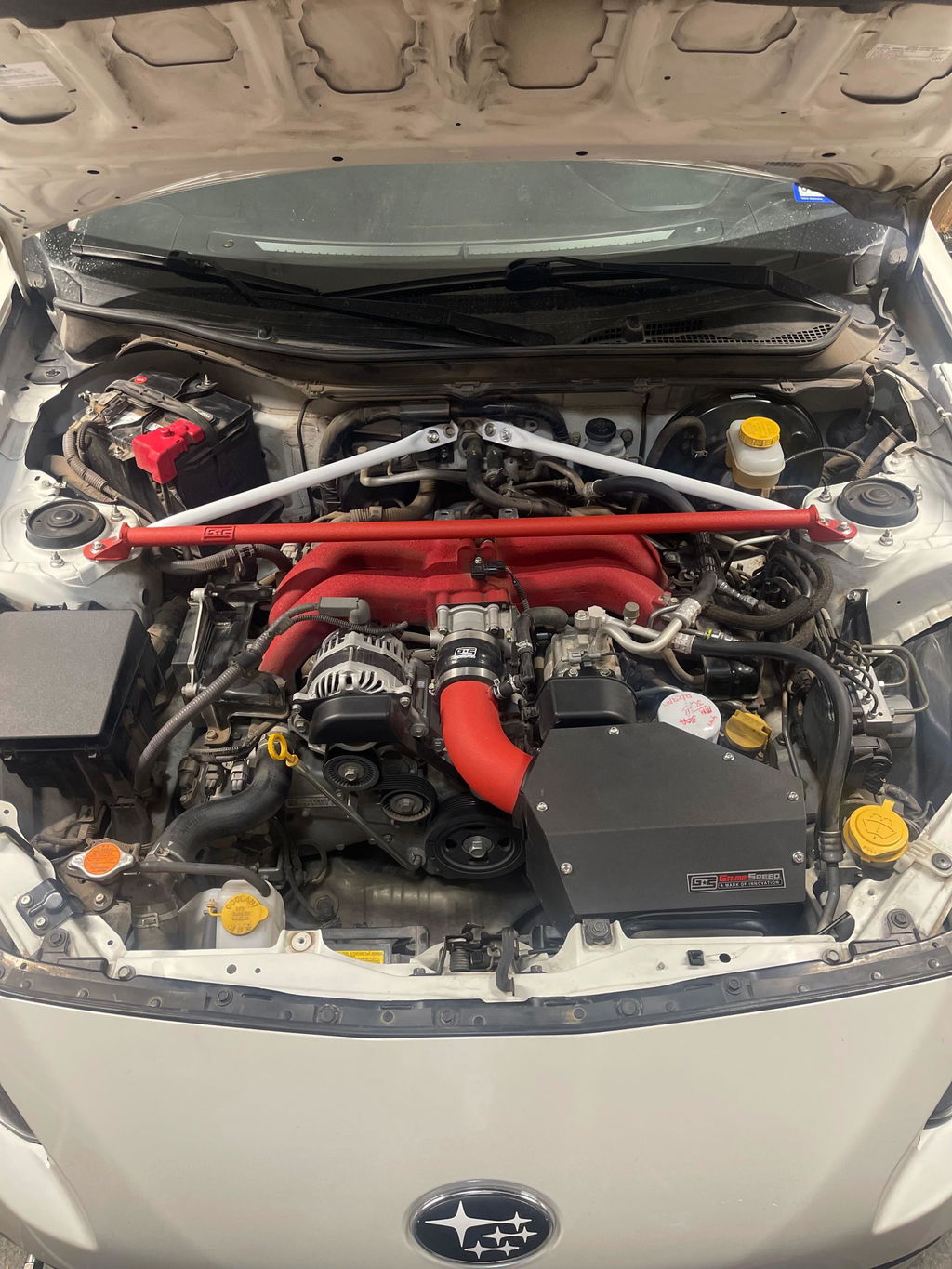
You may have heard the internet claim that strut tower braces are purely cosmetic. We respectfully disagree. Leveraging a deep background in vehicle dynamics and chassis engineering, the GrimmSpeed team spent months testing, measuring, and refining a solution for the BRZ/FRS/86 chassis. With the help of the FT86Club community, we’ve developed a strut tower brace that delivers real, measurable performance.
Quick Specs
- Laser-cut, CNC-bent brackets for perfect fit
- Mild steel construction for maximum stiffness
- Rigid one-piece design eliminates slop and tolerance stacking
- Durable DuPont powdercoat finish
- Autocross-legal in classes allowing strut tower braces only
- Fast installation in minutes with just a single tool
Design
The goal was simple: increase stiffness between the strut towers to improve chassis stability and sharpen steering response. We began by testing both on the street and in the shop, manually flexing the chassis while collecting critical points using a FARO Arm. This data revealed that the OEM triangulation bars perform well, meaning a simple 2-point brace—not a flashy 3-point design—was the optimal solution.
Using 3D scans of multiple vehicles, we quantified manufacturing tolerances to ensure perfect fitment. 3D-printed prototypes allowed us to test bracket designs for both aesthetics and function, speeding up the development process.
A rigid, welded design was chosen to maximize performance. Multi-piece bars add unnecessary complexity, additional welding points, and tolerance stacking, introducing potential failure modes. By keeping the design simple and solid, we achieved maximum stiffness and durability.
Materials
- End brackets: Laser-cut from 3/16" steel and precision CNC bent for optimal strength without compromising thread engagement
- Cross tubes: CNC laser-cut from .125" wall mild steel tubing
- Welding: Robotically welded in a single fixture for unmatched accuracy and repeatability
- Finish: Durable DuPont textured powdercoat with laser-cut stainless steel GS logos for a premium, corrosion-resistant look
Mild steel was selected over stainless because it provides superior stiffness in this application, while still being cost-effective and easy to work with. Stainless steel’s higher yield strength isn’t necessary here, as the forces on the brace are well within mild steel’s capabilities.